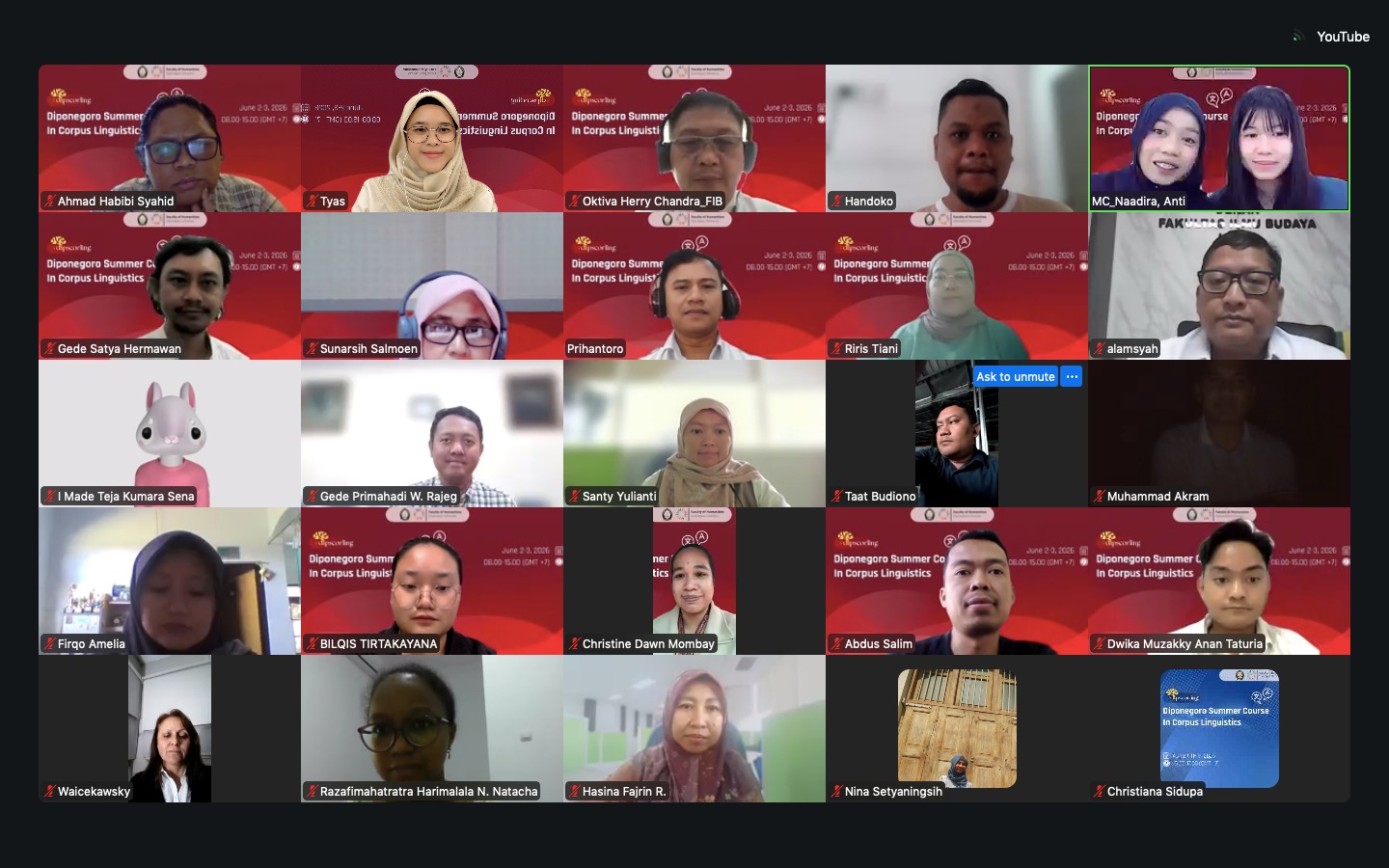
The Undergraduate English Literature Study Program, Faculty of Humanities, Universitas Diponegoro, successfully concluded the Diponegoro Summer Course in Corpus Linguistics (DIPSCORLING) 2026, reaffirming its commitment to fostering international academic collaboration and advancing corpus linguistics education. Organized by the Department of Linguistics, the annual summer course has become one of the flagship international programs of the Faculty of Humanities, providing a platform where students, researchers, lecturers, and language practitioners from various countries can exchange knowledge and engage in discussions on the latest developments in corpus-based linguistic research.
Held online over two intensive days, DIPSCORLING 2026 offered an immersive learning experience that combined theoretical discussions with hands-on practice. Throughout the program, participants explored contemporary approaches to corpus linguistics, learning how corpus-based methods can be applied to linguistic research, language teaching, discourse analysis, and various interdisciplinary studies. The interactive format encouraged participants not only to gain technical knowledge but also to actively engage in academic discussions with fellow participants and internationally renowned scholars.

This year’s program featured an outstanding lineup of speakers from leading institutions. Participants had the opportunity to learn from Dr. Peter Crosthwaite of the University of Queensland, Gede Primahadi Wijaya Rajeg, Ph.D. from Udayana University, Karlina Denistia, Ph.D. from Universitas Sebelas Maret, and Prihantoro, Ph.D. from Universitas Diponegoro. Each speaker contributed unique perspectives on corpus linguistics, introducing participants to current research methodologies, emerging trends, and practical applications of corpus analysis across diverse areas of language studies.
Throughout the sessions, participants were introduced to the complete process of corpus-based research, beginning with corpus compilation and data preparation before moving on to data retrieval, frequency analysis, collocation analysis, and interpretation of linguistic patterns. In addition to methodological discussions, the speakers demonstrated how corpus linguistics can support evidence-based research and language analysis by utilizing digital tools and authentic language data. The program emphasized hands-on learning, allowing participants to practice using corpus tools while receiving direct guidance and feedback from the instructors.

One of the highlights of DIPSCORLING 2026 was the highly interactive atmosphere created throughout the summer course. Participants actively raised questions, shared research experiences, and discussed their own research ideas with the speakers. These exchanges transformed the event from a series of lectures into a collaborative academic forum where participants from different educational and cultural backgrounds could learn from one another while expanding their international professional networks.
The successful implementation of DIPSCORLING 2026 reflects the Undergraduate English Literature Study Program’s ongoing commitment to internationalization and academic excellence. Beyond introducing participants to cutting-edge developments in corpus linguistics, the program also strengthened global partnerships and encouraged future collaborations in research, education, and interdisciplinary language studies. Building on the success of this year’s event, the English Literature Study Program hopes that future editions of DIPSCORLING will continue to attract an even broader international audience and further establish Universitas Diponegoro as a hub for innovative linguistic research and global academic engagement.